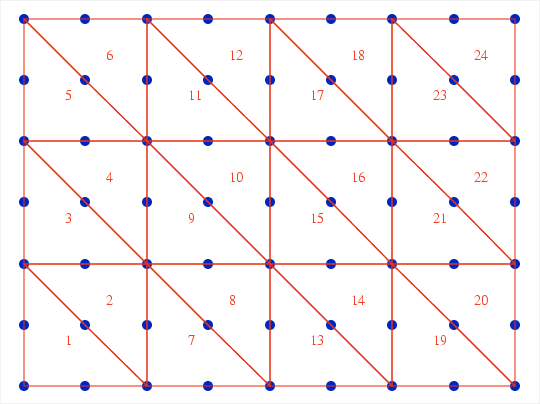
TRIANGULATION_ORDER6 is a data directory which defines the format of files for storing triangulation data of order 6.
Defining a triangulation requires two files:
The six node triangulation, sometimes called a quadratic triangulation, includes the extra three nodes to allow for a higher degree of approximation when a finite element method is used. When listing the six nodes for a given triangle, the first three items are the vertices, in counterclockwise order. The fourth item is the side node between nodes 1 and 2, the fifth the side node between nodes 2 and 3, and the sixth the side node between nodes 3 and 1.
The point sets are distinguished by the values of the following parameters:
At the moment, no facility is provided for allowing the specification of constrained edges, or the existence of holes in the region, both of which are of some interest.
A node file can come from anywhere. In most cases, you generate this data by observation or the characteristics of a particular problem or set of data you are working on. In some cases, you start only with a region, and must fill the region with random points, or with well separated points.
As a simple example, suppose we had the following set of points:
        11 12 13 14 15

         6  7  8  9 10

         1  2  3  4  5
then the node file might look like this:
        #  Node file for simple example.
        #
        0.0  0.0
        1.0  0.0
        2.0  0.0
        3.0  0.0
        4.0  0.0
        0.0  1.0
        1.0  1.0
        2.0  1.0
        3.0  1.0
        4.0  1.0
        0.0  2.0
        1.0  2.0
        2.0  2.0
        3.0  2.0
        4.0  2.0
A triangulation file describes how triangles are formed from the nodes. In an order 3 triangulation, each triangle is described by just 3 nodes. (An order 6 triangulation includes an extra node along the middle of each side). If you have nodes, but no triangulation of them, then there are programs available which can form a Delaunay triangulation of the nodes.
This triangulation will be order 3, so it is then necessary to convert the triangulation to order 6 by adding the midside nodes of each triangle.
An order 6 triangulation of these nodes is:
        11-12-13-14-15
         |\    |\    |
         | \   | \   |
         6  7  8  9 10
         |   \ |   \ |
         |    \|    \|
         1--2--3--4--5
in which case the triangle file would look like this:
        #  Triangle file for simple example.
        #
         1  3 11  2  7  6
        13 11  3 12  7  8
         3  5 13  4  9  8
        15 13  5 14  9 10
The triangles could be listed in any order.
The computer code and data files described and made available on this web page are distributed under the GNU LGPL license.
FEM2D, a data directory which contains examples of 2D FEM files, three text files that can be used to describe many finite element models;
FEM_BASIS_T6_DISPLAY, a MATLAB program which displays a basis function associated with a 6-node triangle "T6" mesh.
MESH_BANDWIDTH, a C++ program which returns the geometric bandwidth associated with a mesh of elements of any order and in a space of arbitrary dimension.
TRIANGULATION, a C++ library which performs various operations on order 3 ("linear") or order 6 ("quadratic") triangulations.
TRIANGULATION_DISPLAY_OPENGL, a C++ program which reads files defining a 2D triangulation and displays an image using OpenGL.
TRIANGULATION_ORDER3, a data directory which contains examples of TRIANGULATION_ORDER3 files, a description of a linear triangulation of a set of 2D points, using a pair of files to list the node coordinates and the 3 nodes that make up each triangle.
TRIANGULATION_ORDER4, a data directory which defines TRIANGULATION_ORDER4 files, a description of a triangulation of a set of 2D points, using a pair of files to list the node coordinates and the 4 nodes that make up each triangle (3 vertices and the centroid);
TRIANGULATION_ORDER6, a dataset directory which contains examples of TRIANGULATION_ORDER63 files, a quadratic triangulation of a set of 2D points, using a pair of files to list the node coordinates and the 6 nodes that make up each triangle;
TRIANGULATION_PLOT, a C++ program which makes a PostScript image of a triangulation of points.
BOX6 is a rectangular region.
The smallest angle is 45 degrees.
There are 63 nodes and 24 elements.
You can go up one level to the DATA page.