latin_edge, a C++ code which makes Latin Edge Squares.
A Latin square is a selection of one point from each row and column of a square matrix or table. In M dimensions, the corresponding item is a set of N points, where, in each dimension, there is exactly one point whose coordinates are in a given "column" or range of values. To emphasize the use of higher dimensions, these objects are sometimes called Latin hypersquares.
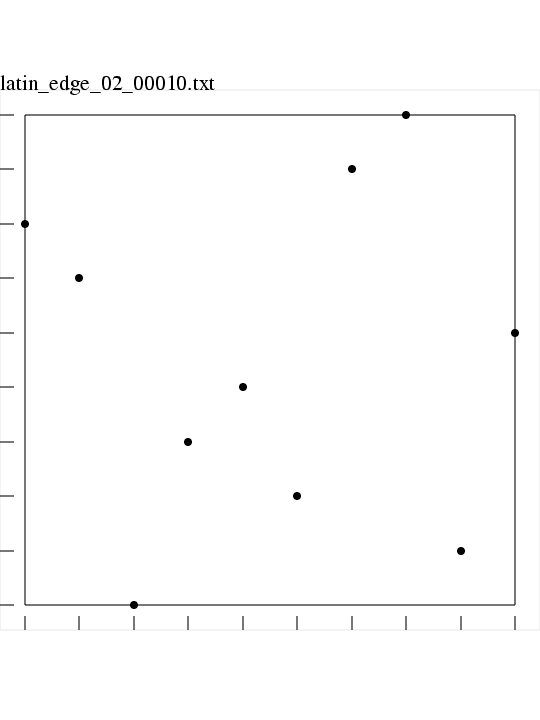
Once a Latin square has been selected, the center of each subsquare is chosen to yield a Latin Edge Square dataset. This is the same technique that yields a Latin Center Square dataset, with the difference that the mapping from the Latin Square to the unit square is shifted in such a way that the lowest and highest possible coordinate values are 0.0 and 1.0, instead of 1/(2*N) and (2*N-1)/(2*N).
Here is an image of a Latin edge grid with spatial dimension M = 2 and number of points N = 10.
The computer code and data files described and made available on this web page are distributed under the MIT license
latin_edge is available in a C++ version and a FORTRAN90 version and a MATLAB version.
BOX_BEHNKEN, a C++ code which computes a Box-Behnken design, that is, a set of arguments to sample the behavior of a function of multiple parameters;
CVT, a C++ code which computes points in a Centroidal Voronoi Tessellation.
FAURE, a C++ code which computes Faure sequences.
HALTON, a C++ code which computes elements of a Halton Quasi Monte Carlo (QMC) sequence, using a simple interface.
HAMMERSLEY, a C++ code which computes elements of a Hammersley Quasi Monte Carlo (QMC) sequence, using a simple interface.
IHS, a C++ code which computes improved Latin Hypercube datasets.
LATIN_CENTER, a C++ code which computes Latin square data choosing the center value.
LATIN_COVER, a C++ code which produces N Latin squares which cover an NxN square, or NxN Latin cubes which cover an NxNxN cube.
LATIN_RANDOM, a C++ code which computes Latin square data choosing a random value in the square.
NIEDERREITER2, a C++ code which computes Niederreiter sequences with base 2.
NORMAL, a C++ code which computes elements of a sequence of pseudorandom normally distributed values.
SOBOL, a C++ code which computes Sobol sequences.
UNIFORM, a C++ code which computes uniform random values.
VAN_DER_CORPUT, a C++ code which computes van der Corput sequences.